Small Lot Stormwater Management, Creative Solutions When There Is Nowhere for the Water to Go
Small urban lots leave little or no room for a traditional stormwater basin, so your stormwater management has to fit inside the building, the courtyard, and the streetscape. These projects usually answer to the local stormwater ordinance, and the smartest designs meet those requirements without costing you buildable space.
No Basin. No Buffer. No Easy Answers.

On a greenfield site, stormwater management follows a familiar logic. You grade the land, size a detention basin, and route runoff through a system designed from scratch around your project. Urban stormwater management works differently.
Urban infill removes most of the traditional options. When you build on a half-acre downtown site surrounded by streets, alleys, adjacent structures, and decades of existing infrastructure, you work with nearly 100 percent impervious coverage and no open ground for a basin. But, every gallon of rain that falls on your site still needs to go somewhere, and your engineering team must decide where before you finalize the design.
Your Municipality Usually Sets the Rules
Many developers assume every project runs through a state stormwater permit. On small urban lots, that may not be the case. In Pennsylvania, the state NPDES construction permit generally applies when a project disturbs one acre or more. Many small infill projects fall below that line, so your design answers to the local stormwater management ordinance instead. Each municipality adopts its ordinance under Pennsylvania’s Stormwater Management Act (Act 167), so runoff volume, rate, and water quality requirements vary from one city to the next. In Allentown, for example, the stormwater ordinance (Chapter 538) sets its project thresholds according to the governing Act 167 plan.
For a small urban lot, that typically means three things.
- Your municipality’s stormwater ordinance sets the volume, rate, and water quality targets your design must meet.
- Your project still needs erosion and sediment controls during construction, plus a written erosion and sediment control plan once disturbance reaches 5,000 square feet.
- Your project may still need a state NPDES permit if it disturbs less than an acre but belongs to a larger common plan of development.
Because the ordinance, not the size of a basin, drives your design, creative engineering matters more on a small lot than almost anywhere else.
Creative Stormwater Solutions That Fit on a Small Lot
When you can’t spread out, you build stormwater management into the site itself. Green stormwater infrastructure and low impact development tools let you meet your municipal requirements while keeping the square footage your building program needs. Common approaches include the following.
- Underground storage under a parking lot holds runoff and releases it slowly, keeping the surface free for parking.
- Green roofs capture, treat, and slow rainfall before it ever reaches the ground.
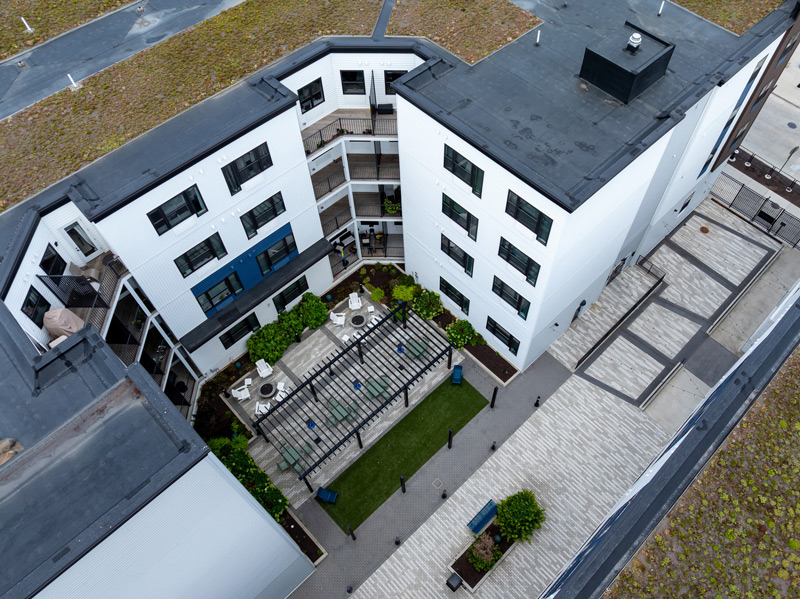
- Courtyard planters treat runoff and double as amenity space for your residents or tenants.
- Level spreader structures release water evenly and protect adjacent gutters and sidewalks.
- Water quality inlets filter runoff before it enters the municipal storm sewer.
- Porous pavement systems let rainfall soak through the surface and into storage below, turning hardscape into stormwater management.
- Tree wells and subsurface infiltration beds let runoff soak into the ground beneath sidewalks, plazas, and courtyards.
- Carefully sized connections to existing municipal infrastructure respect the limited capacity of older pipes.
The right mix depends on what your site allows, what your building program needs, and what your municipality requires.
What This Looks Like in Downtown Allentown
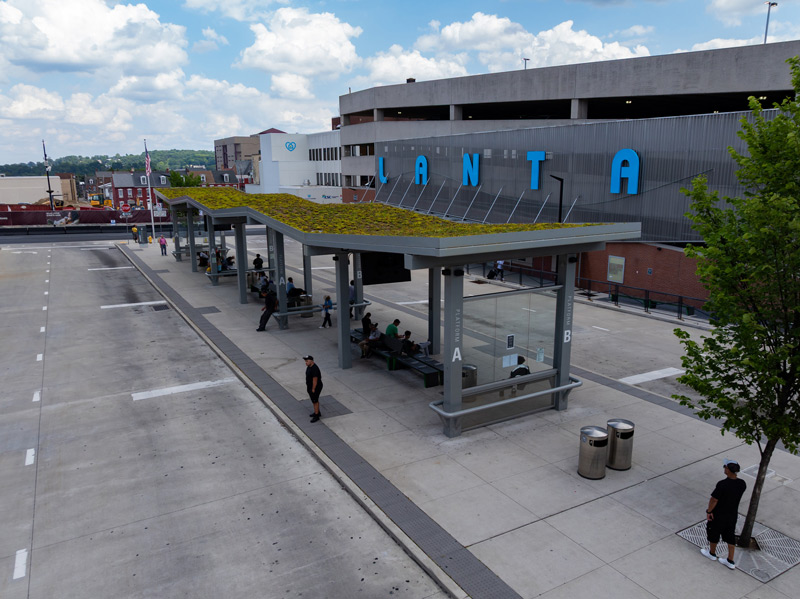
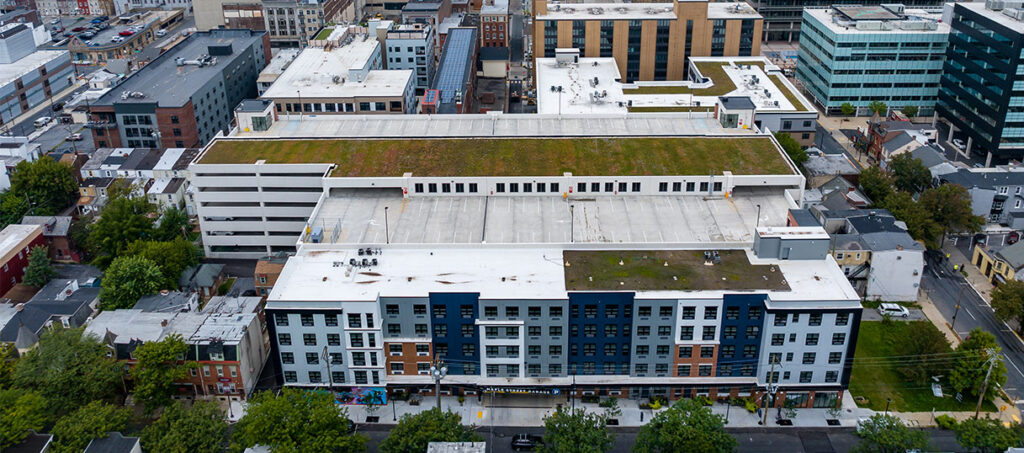
RETTEW has worked through these constraints across more than a decade of stormwater management on downtown development projects in Allentown, PA. At 1010 Hamilton Apartments, RETTEW designed a stormwater management system that pairs a green roof with a water quality inlet, uses courtyard planters to reduce impervious cover as a self-crediting control, and includes a custom-designed level spreader structure to control runoff to adjacent gutters, supporting the project’s LEED certification goals in the process. Green roofs appear across RETTEW’s downtown Allentown work, including Maple Street Garage, Walnut View, Cityplace South, Center Square Lofts East and West, 1 Center Square, Tower Six, Walnut Street Commons, 520 Hamilton, Three City Center, Strata West, and Strata Symphony. On each project, RETTEW’s civil scope accounted for how the roof reduced the load on the site’s drainage design. At The Hive Residences, a two-building apartment complex in the heart of downtown, RETTEW designed a stormwater conveyance system on a site complicated by potentially historic structures. Because the site covers well over one acre, RETTEW supported the project’s state NPDES permitting with hydrological calculations. The building’s green roof also helps reduce the load on the site’s drainage system. At the Allentown Transportation Center, a public transit plaza serving 3,000 daily passenger trips, RETTEW’s civil engineering scope included stormwater management plans that worked around the site’s origami-inspired bus shelter pavilion, including a green roof on the pavilion itself.
Start With What Is in the Ground
Creative design starts with your site’s actual existing conditions, which may not match what the records show. On urban infill sites, storm sewer connections are frequently undersized, mislocated, or simply not where the as-builts indicate. Designing around the actual condition, rather than potentially outdated documents, is a routine part of urban infill civil engineering, and early site investigation pays for itself many times over before you submit a plan for review.
That same local knowledge carries into review. City engineers and municipal reviewers develop institutional knowledge about specific blocks, drainage systems, and recurring concerns in their part of the city. When your engineering team has worked with those reviewers across many projects, the design can account for these nuances resulting in fewer surprises in the review cycle.
Experience Built in Allentown Travels to Your Site
Small site stormwater experience doesn’t transfer automatically from greenfield work. In Allentown, RETTEW has designed stormwater solutions for residential towers, adaptive reuse conversions, parking structures, public plazas, and streetscape projects. That repetition in a dense urban environment builds problem-solving instincts that apply anywhere. Every municipality writes its own ordinance, but the creative toolkit and the habit of designing around a site’s real constraints travel with our team to your project, wherever it is.
Bring Your Engineer In Before You Lock In a Site Plan
On a small urban site, stormwater decisions shape your building footprint, your amenity spaces, and your budget. The earlier you involve a civil engineer who has solved this problem before, the more options you keep open, from green roofs to subsurface systems that infiltrate to a smarter tie-in with the city’s system. RETTEW brings more than a decade of downtown Allentown experience to infill projects across Pennsylvania and the mid-Atlantic. If you’re evaluating a site now, talk with us before you commit to a design approach.
Frequently Asked Questions
Do small urban projects in Pennsylvania need a state stormwater permit? In most cases, no. Pennsylvania’s NPDES permit for construction activities, which includes a post-construction stormwater management (PCSM) plan, generally applies when a project disturbs one acre or more. Smaller projects typically follow the municipality’s stormwater ordinance instead, though a project under one acre can still need a state permit if it belongs to a larger common plan of development. It’s important to confirm each project with your local agencies.
Who sets stormwater requirements for a small infill lot? Your municipality does, through a stormwater management ordinance adopted under Pennsylvania’s Act 167. Requirements for runoff volume, rate, and water quality vary from one municipality to the next.
What stormwater solutions work on small urban lots? Green roofs, tree wells and planters that infiltrate stormwater, pervious surfaces on courtyards and walkways, subsurface stormwater basins, and water quality inlets all help you manage runoff without giving up buildable space. The right mix depends on your site, your building program, and your local ordinance.
Why is stormwater management harder on urban infill sites than on greenfield sites? A greenfield site usually has room to grade the land and build a detention basin. An urban infill lot is often close to 100 percent impervious with no open ground, so your engineer has to build stormwater management into the building and site design itself.
Why does local experience matter for stormwater approvals? Municipal reviewers build knowledge about specific blocks, drainage systems, and recurring concerns in their city. A team with a local track record can structure your submission around what reviewers look for and move through review with fewer surprises.
Further Reading
These resources offer more context on stormwater management, small urban site design, and municipal stormwater requirements in Pennsylvania.
EPA, Stormwater to Street Trees, Engineering Urban Forests for Stormwater Management
City of Allentown Stormwater Management Ordinance (Chapter 538)
PA DEP, Construction Stormwater (Chapter 102)
ULI, Small-Scale Infill Projects Add Density to Tight Sites
Barbara Mahaffey
Contact


