Utilities Are Running Out of Time to Catch Up
Utilities have always worked within long planning cycles, and for good reason. Substations are designed for decades. Capital improvement plans stretch across budget years. Permitting, procurement, and construction timelines are measured in years, not months. That institutional pace is now colliding with a demand curve that isn’t waiting.
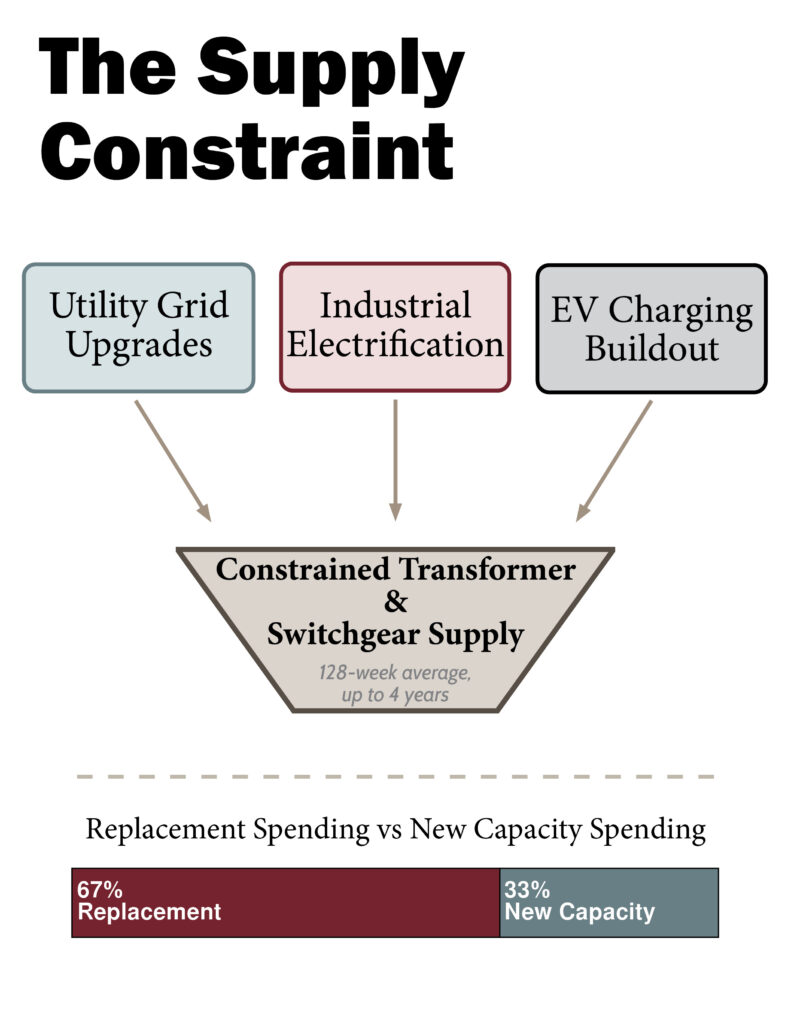
The equipment problem alone is severe. As of early 2024, lead times for large power transformers averaged 128 weeks, with some units requiring more than four years to complete. For projects already in motion across Pennsylvania, Ohio, and West Virginia, that timeline isn’t a planning consideration. It’s a hard constraint. But those lead times reflect more than increased demand. Large power transformers require specialized materials, precision manufacturing, and production processes that only a handful of facilities worldwide are equipped to handle. When demand surges globally, as it has in recent years, the queue lengthens with no quick way to expand capacity.
This isn’t a temporary supply chain disruption. Domestic manufacturers are meeting only about 20% of the country’s power transformer needs, leaving imports to fill the gap. According to Wood Mackenzie, the U.S. faced a 30% shortfall in power transformers and a 10% deficit in distribution transformers in 2025, with most specifications expected to remain in marginal shortage through 2030.
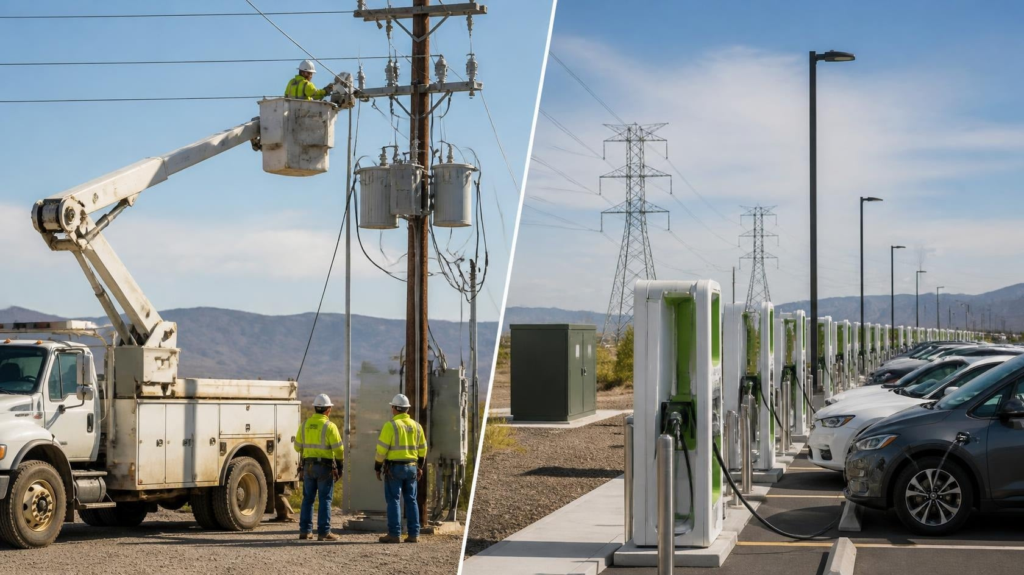
That shortage is being compounded by competing demand from outside the utility sector. EV charging infrastructure is adding another layer of competition for the same constrained equipment pool. Fast-charging corridors, municipal fleet electrification programs, and workplace charging buildouts are all drawing on distribution transformers and switchgear at exactly the moment when utility grid upgrades need those same components. For project teams trying to sequence capital work across a multi-year plan, competition for equipment is not a future concern. It is already showing up in their procurement timelines.
A utility that identifies a critical need today and orders equipment tomorrow may not take delivery for two to four years. In a region where demand is accelerating and deferred maintenance is already compressing the planning window, that gap between decision and delivery is where projects stall, costs climb, and ratepayers feel the impact.
We’ve watched equipment availability replace capital and permitting as the primary constraint on project timelines. But equipment is not the only pressure point. Utilities across the region are contending with workforce constraints, as the pool of skilled tradespeople and engineers needed to plan, permit, and construct infrastructure upgrades has not kept pace with the volume of work now in motion. Permitting and environmental review timelines have also lengthened as regulatory agencies manage a growing volume of project applications.The result is a project environment where almost every variable that affects schedule is moving in the wrong direction all at once.
The capital investment patterns we see across RETTEW’s project work tell a similar story. Spending on distribution infrastructure increased by 160% from 2003 to 2023, reaching $50.9 billion in 2023 alone, and about 80% of the $186.4 billion spent by U.S. investor-owned utilities in 2024 went to infrastructure upgrades. But that spending is largely reactive, replacing what fails rather than building for what comes next. In 2024, 67% of utility spending on transmission and distribution went to replacements and upgrades, totaling $63 billion, while only $32 billion went to new lines and substations. The industry is treading water, not getting ahead.
And the impact is becoming visible to ratepayers. Utilities pay capacity prices to ensure there is enough generation available to meet peak demand, and those costs are passed through to customers as partof their utility bills. PJM Interconnection, the regional transmission organization managing the grid across thirteen states and jurisdictions in the Mid-Atlantic and Midwest, saw capacity prices soar from $28.92 per megawatt-day in 2024/25 to $329.17 per megawatt-day in the 2025/26 delivery year, a more than tenfold increase in a single year that is already working its way into what customers pay.
For utilities, the rate impact is both a symptom and a warning. The compression that is driving capacity prices higher is the same compression reshaping how planning conversations happen on the ground.
RETTEW’s conversations with utility clients have shifted. They’re not asking whether demand is coming. They’re asking how to respond to demand that’s already here. The work we’re doing with clients isn’t about whether to upgrade aging infrastructure or plan for large load interconnection requests. It’s about sequencing. How do you prioritize capital when everything needs attention at once and a new large load inquiry, whether from a data center, an industrial facility, or an EV charging corridor, can arrive before the last study is finished?
Utilities in this region are confronting a compression problem. Decades of deferred investment are meeting an unprecedented acceleration in demand, with supply chains constrained, permitting processes under pressure, and ratepayers watching their bills climb. The engineering challenge is real. So is the urgency. The firms and utilities that start planning for that reality now will be better positioned than those waiting for conditions to stabilize. From where we sit, working alongside utility clients across the region, that work has already begun.
Additional reading: Wood Mackenzie / eepower: Transformer Supply Chain Woes | IEEFA: PJM Capacity Prices
Russalle Zambelli
Ms. Zambelli is a Utilities & O&G Market Lead for RETTEW's energy, development, and industrial clients. She has more than 15 years of experience in securing oil and gas, right-of-way, land, and survey lease agreements. Ms. Zambelli is adept at building and maintaining client relationships by communicating regularly with clients and understanding their needs. She also develops new relationships with potential clients, negotiates master service agreements, and uses her business development expertise to communicate with land owners, survey, geotechnical, engineering, and environmental clientele.
Contact


